
You can't regulate what you haven't yet learned to notice.

Nature helps me reset as always
I found myself wondering recently whether summer joy was just for the kids—and whether all moms secretly spend these months feeling fried, exhausted, and quietly wishing for fall to arrive.
This summer I intentionally gave my kids more unstructured space to simply be kids. Meanwhile, I found myself navigating new schedules, less alone time, terrible sleep, and some particularly wacky perimenopause hormones.
Most days I felt anxious, tired, and tense. Trying to power through workouts wasn't helping. I noticed myself becoming more easily triggered and less able to simply "push through" the way a younger version of me—or maybe just my Type A brain—expected me to.
What I actually needed was rest and recovery.
My habit, unfortunately, is to ignore that need.
Always learning.
So instead of asking, “How do I do all the things?” I started asking, "What would help my body feel calmer today?"
First, I focused on the basics, eating and resting well and nothing else. Within a few days, I was able to come back to a handful of daily health practices that helped me feel more like myself. More walks. More quiet. More breathing room. More honest check-ins. More sleep. I also picked up Heal Your Nervous System by Linnea Passaler again and found myself returning to one simple but powerful idea.
Before we can regulate and calm our nervous system, we have to notice it.
And really, accept it as it is. It sounds obvious. It isn't for me.
Most of us move through the day reacting automatically. We assume we're making thoughtful decisions, when in reality our nervous system has often decided whether we're safe, stressed, connected, or overwhelmed long before our thinking brain catches up.
That isn't a personal failure. It's biology.
The good news is that awareness can be practiced.
Not perfectly. Just repeatedly.
Awareness Comes Before Change
When people hear "nervous system regulation," they often imagine breathing exercises, meditation, cold plunges, or elaborate morning routines.
Those tools can absolutely help. I love those practices dearly.
But none of them matter very much if we don't first pause to notice what's happening inside us.
Can you recognize when your shoulders creep toward your ears? When your jaw is clenched? When your breath is shallow?
Can you tell the difference between being present and living distracted?
Can you notice when you're rushing, people-pleasing, shutting down, or becoming reactive?
Are you genuinely giving yourself enough rest and restore time?
Awareness isn't the finish line.
It's the first step.
Expanding the Space Between Trigger and Response AKA The Gap

The practice of creating space between a stimulus and a response is deeply rooted in Buddhism, but versions of the same idea appear in many contemplative traditions, modern psychology, and neuroscience.
One of the greatest gifts of nervous system awareness is that it reminds us to create just a little more space and wiggle room.
Something happens, as it often does. Someone says something unexpected, your child melts down, traffic backs up, you receive yet another difficult email or work slack.
Oftentimes, our reactions are almost immediate. They don’t have to be.
The goal isn't to eliminate our reactions.
The goal is to slowly expand the gap between what happens and how we respond.
Sometimes that gap is only one breath.
Sometimes it's noticing your clenched jaw before the words leave your mouth.
Sometimes it's realizing,
"I'm feeling stressed or extra reactive right now,. This can wait."
From Dog Mind to Lion Mind
One idea from Passaler's book has stayed with me. It’s a tibetan metaphor used to describe two different ways of encountering situations.
Dog Mind and Lion Mind.
Dog Mind reacts to every sound, every movement, every possible threat. It's constantly scanning, constantly barking, constantly convinced that everything deserves immediate attention. Sound familiar?
Lion Mind is different. A lion notices what matters. It conserves energy. It responds when necessary, but it doesn't waste precious energy reacting to every rustle in the grass.
Sometimes I wonder if smartphones were designed to keep us permanently living in Dog Mind. Every ding, buzz, breaking news alert, and unread message whispers, "Pay attention right now." Just thinking about this has me wanting to turn off some alerts.
Emails. News. Schedules. Group texts. Chores. Perimenopause. The endless mental tabs we keep open.
The invitation isn't to become emotionless.
It's to become more discerning.
Not everything deserves a five-alarm nervous system response. Not everything deserves to take up mental space.
Build Your Own Nervous System Alertness Elevator
Another idea I love is imagining your nervous system like an elevator.
Rather than thinking you're either "calm" or "stressed," imagine several floors, as follows. For example, I’m blue when I’m practicing yoga, green when I’m teaching, yellow when my schedule goes sideways, and red when both of my kids are melting down at the same time.
🔵 Blue - Ground Floor: Calm, relaxed, deeply rested, connected, peaceful
🟢 Green - 2nd Floor: Focused, productive, engaged, harmonious, open
🟡 Yellow - 3rd Floor: Increased anxiousness, ruminating thoughts, chest breathing
🔴 Red - 4th Floor: High alert, fear driven, irritable, overwhelmed, impatient
🟣 Purple - Top Floor: Fight, flight, freeze, or complete shutdown
If only we could live on the blue floor forever, but we know that is not the way of human life.
Some days take you to the 4th floor whether you want to go there or not.
The goal is learning to recognize where you are. And giving yourself the gift of rest and recover time when needed so you can resettle back to the green and blue states.
I make a point to check in once per day and reflect on where my nervous system was the majority of the day. During my summer kickoff chaos season, I was living between red and yellow several days a week, for several weeks. My sleep was affected and my mood was all over the place.
Reflection Moment
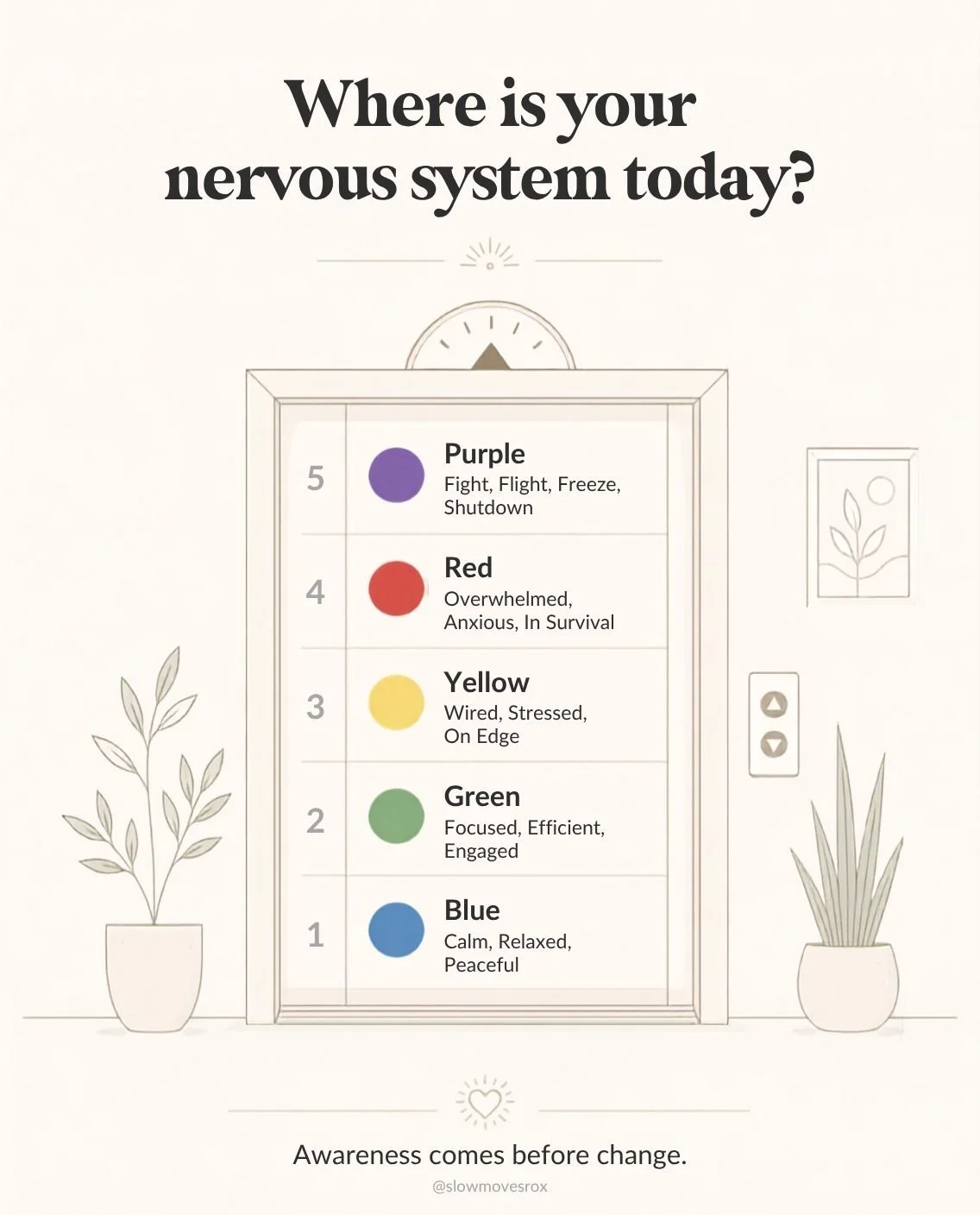
Take a few minutes this week to reflect on your own Alertness Elevator.
What does each floor feel and look like for you?
What thoughts tend to appear?
What happens in your body?
What helps you move down a floor when you need to?
For me:
hiking
quiet, slower mornings
yoga
a good night's sleep
a massage
time outside
The more familiar your map becomes, the easier it is to recognize your patterns in everyday life.
Nervous system awareness isn't about becoming perfectly calm.
It's about becoming familiar with yourself.
Little by little, you begin to notice patterns that used to stay invisible.
And once you can see them, you have more options.
Conclusion

One thing I've become more aware of is how often I try to ignore the yellow and red states instead of giving myself the rest and recovery I genuinely need.
Somewhere along the way, I learned that productivity should win. That pushing through was somehow more important than slowing down.
I'm not sure I believe that anymore.
Don't I want my kids to grow up noticing what their bodies need? To rest when they're tired, to move when they're restless, and to trust that recovery isn't something you earn?
Maybe I should practice that too.
Nervous system awareness isn't about becoming perfectly calm.
It's about becoming more familiar with yourself.
And with that familiarity comes choice.
⬇️ What floor does your nervous system live on most these days?
🌿 Part of the Heal Your Nervous System series
Lately, I’ve been slowly working through ideas inspired by Heal Your Nervous System and reflecting on what nervous system healing can look like in real, everyday life.
This series explores gentle structure, sensory support, movement, nourishment, and the small rhythms that help the body feel safe enough to heal.
Read next:
(⏪ Previous Post) - Creating A Daily Rhythm That Helps Your Nervous System Feel Safe
(⏭️ Next Post: Coming Soon!) - Building Nervous System Agency Through Embodiment