
When Is It Time To Treat Perimenopause Symptoms?
How I knew lifestyle support wasn't enough anymore—and what I wish I'd understood sooner.

Finding our way through life one hike at a time!
For a long time, I thought feeling healthy mostly came down to doing the right things.
Move your body. Eat nourishing food. Get enough sleep. Manage your stress. Spend time outside. Take care of yourself.
I’ve spent much of my adult life working in movement and wellness, and I genuinely believe in the power of those things. I still do.
But perimenopause complicated that story for me.
At some point, the question stopped being, What else can I do to support myself? and became:
Wait. Am I trying to lifestyle my way through symptoms that actually deserve treatment?
That was a much harder question for me to answer.
When does normal change become something worth treating?
Perimenopause is a normal hormonal transition, not a disease.
But “normal” does not mean you have to suffer through it.
There is no single symptom, age, lab result, or magic number that tells every woman: Okay, now your symptoms are bad enough to deserve treatment.
A more useful question might be:
How much are these symptoms affecting the way I actually live?
Are you regularly losing sleep?
Have changes in mood, anxiety, or irritability begun affecting your relationships or your ability to feel like yourself?
Are hot flashes or night sweats disrupting your days or nights?
Are joint or muscle symptoms making movement less enjoyable?
Are vaginal, sexual, or urinary changes causing discomfort?
Are you exhausted enough that you're organizing your life around your energy?
Or have a collection of smaller symptoms simply started adding up?
You don’t have to wait until things become unbearable before asking for help.
I kept thinking I could manage it myself
My first obvious sign of perimenopause was that my cycles started becoming more erratic after the birth of my son, when I was 43. My OB-GYN basically said, “You’re probably in perimenopause. Keep doing all the healthy things. Good luck.”
And for a while, that seemed reasonable. It wasn’t exactly an easy season of life, but I was still active and nourishing myself reasonably well—for a midlife mom of two living through a pandemic.
Then, at an annual checkup with my GP, I was told I had prediabetes. It scared the crap out of me and spun me into action. My dad had type 2 diabetes, and I did not want to go down that path if I could help it.
I spent the next few years learning about blood sugar and working pretty aggressively to improve my metabolic health. Along the way, I noticed some welcome side effects: my mood and energy felt steadier, my body weight stabilized, and even my cycles became more regular.
For a while.
I wholeheartedly believe that movement, nutrition, stress management, sleep habits, and other daily practices can have a huge effect on how we feel throughout our lives—including during perimenopause. I don't see medical treatment and lifestyle support as opposing camps.
But I eventually learned that there is a limit to what lifestyle can fix.
Over the course of about a year, my symptoms became harder and harder to manage. My sleep grew wildly unpredictable. No matter what I did, I couldn't seem to secure myself a solid night's rest. I've always been someone who needs her 8.5 hours, and the accumulated sleep deprivation started affecting my mood, energy, and ability to focus.
My libido basically disappeared. I felt like I had a UTI all the time, even though I didn't. Sex stopped feeling good. Then came intense joint pain throughout my body that began interfering with the things I loved to do.
And honestly, it was difficult to know what belonged to perimenopause and what belonged to life.
It had been a full era. I'd had a surprise baby at 43 during a pandemic, while my older child was supposed to be entering kindergarten and schools weren't even open. I was hospitalized several times for health issues related to my C-sections. I lost a career I loved. And then my dad died unexpectedly.
Of course I was tired. Of course I was stressed. Of course I didn't feel quite like myself.
So I think I spent too long asking what I should be doing better.
Maybe I needed to eat differently.
Exercise differently.
Manage my stress better.
Improve my sleep routine.
Take another supplement.
Recover more.
There was always another lever I could pull.
Eventually, though, I realized that trying harder at wellness was becoming part of the problem.
My body wasn't asking me to become more disciplined. It was giving me information.
I just wasn't hearing it yet.
Quality of life counts
One of the most helpful shifts for me was beginning to think about perimenopause treatment in terms of quality of life.
Symptoms don't have to be catastrophic to matter.
If you aren’t sleeping well for months, that matters.
If sex suddenly hurts, that matters.
If you stop doing activities you love because your joints hurt, that matters.
If anxiety feels unfamiliar or your moods are affecting your relationships, that matters.
If hot flashes are interfering with work or sleep, that matters.
If you are spending a significant amount of mental energy trying to manage how you feel, that matters too.
You don't have to prove that your symptoms are severe enough to earn care.
And you don't necessarily need to know whether every single symptom is being caused by perimenopause before you bring it up.
You can simply start with:
Something has changed, and it is affecting my life.
Track patterns, not perfection
Tracking can be so helpful
One reason I am a lifelong fan of tracking in general: because it helps tell a story that’s hard to see while you’re in the day-to-day of living life.
When symptoms creep up gradually, we adapt.
Maybe you start going to bed earlier because you're exhausted. You stop drinking wine because suddenly it wrecks your sleep. You modify your workouts because your joints hurt. You carry a fan. You schedule less. You start buying supplements. You tell yourself you're stressed.
Each adjustment can seem small on its own.
Taken together, they can tell a much bigger story.
Tracking helped me see that story.
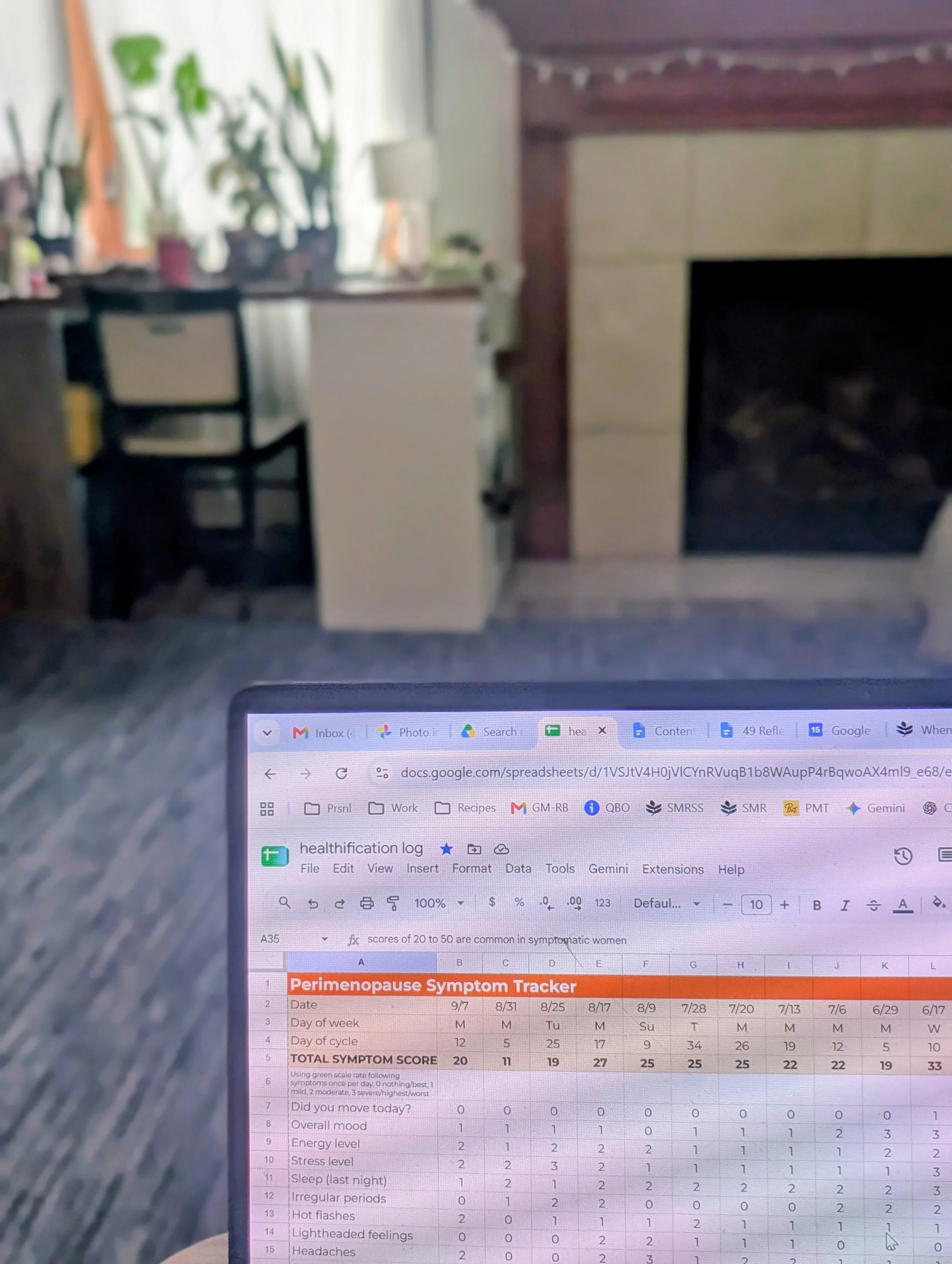
When I finally started regularly checking in with my symptoms using the Greene Climacteric Scale, as recommended by Dr. Mary Claire Haver—one of my favorite menopause educators and authors—it became clear that I was struggling more than I had realized.
My total symptom score was in the 30s. Seeing everything together on one page was surprisingly validating. It wasn't just bad sleep over here, aching joints over there, low libido somewhere else. The cumulative symptom burden was affecting my quality of life.
That gave me something concrete to bring to my healthcare provider and helped shift the conversation from How can I manage this better? to What treatment options might actually help?
And later, as I began treatment, the same tracker gave me a way to see whether I was actually feeling better—not symptom by symptom, day by day, but across the bigger picture.
You don't need an elaborate spreadsheet—although I personally love one.
A notebook, app, calendar, or simple weekly check-in can help you notice what is changing and whether those changes are affecting your life.
If you want more help with this, I created a perimenopause symptom tracker and wrote a separate article about why tracking has been so useful for me.
[[🔗 Why Tracking Your Perimenopause Symptoms Is a Game Changer]]
Treatment doesn't automatically mean hormone therapy
This distinction matters.
Deciding that your symptoms deserve treatment does not mean deciding on your own that you need hormone therapy.
It means deciding that your symptoms deserve a real conversation.
Depending on your symptoms, health history, age, preferences, and other factors, that conversation might include lifestyle changes, treatment for a specific symptom, hormone therapy, nonhormonal medications, vaginal therapies, mental health support, sleep support, or evaluation for another medical issue.
Because not every midlife symptom is caused by perimenopause.
Thyroid conditions, iron deficiency, sleep disorders, medication effects, depression, anxiety, and other health conditions can overlap with symptoms women experience during the menopause transition.
That isn't a reason to dismiss perimenopause.
It's a reason to look at the whole picture.
When I knew I wanted more help
After the slow buildup of symptoms over the course of about a year, the joint pain kicked in—and kept getting worse. There were several weeks when I couldn’t do my normal movement activities, which was basically the straw that broke this camel’s back.
Regular movement is my lifeline. It’s sometimes my job, one of my favorite ways to spend my time, and a major regulator of my mental health. When pain started taking that away from me, I finally took the full picture of my symptoms more seriously.
I didn’t want to keep adapting my life around feeling lousy. I wanted to understand what was happening and what my options were. So I started looking for a provider who could help me have that conversation.
For me, seeking treatment wasn't an admission that my healthy habits had failed.
That distinction took me a while to understand.
Movement still mattered.
Strength still mattered.
Food still mattered.
Sleep and recovery mattered more than ever.
But I stopped expecting those things to single-handedly solve every problem happening inside a changing hormonal system.
I could support my body and seek medical care.
Those things could belong in the same picture.
Some signs it may be time to have the conversation
You don't need to wait for a particular number of symptoms, but it may be worth making an appointment when:
Symptoms are regularly affecting your sleep or energy
Mood changes, anxiety, irritability, or brain fog are affecting daily life
Hot flashes or night sweats are disruptive
Vaginal dryness, painful sex, urinary symptoms, or recurrent UTIs are affecting your comfort
Joint or muscle symptoms are interfering with activities you enjoy
Your menstrual bleeding has changed significantly
Your symptoms are becoming harder to manage with the strategies that used to work
You find yourself continually reorganizing your life around how you feel
You simply want to understand your options before symptoms become more disruptive
You don't have to check every box.
You also don't have to wait until you've exhausted every possible lifestyle intervention first.
And sometimes, don't assume it's perimenopause
There is another side to this conversation.
Perimenopause is common in midlife, but it shouldn't become the explanation for every symptom a woman experiences between 40 and 55.
New, unusual, severe, or persistent symptoms deserve appropriate medical evaluation.
Changes in bleeding are especially worth discussing with a healthcare provider, particularly very heavy or prolonged bleeding, bleeding between periods, or bleeding after sex.
And symptoms such as chest pain, significant difficulty breathing, fainting, severe pain, or thoughts of self-harm call for urgent medical attention rather than waiting for a routine perimenopause appointment.
Curiosity works both ways:
Could this be perimenopause?
And:
Could something else be going on?
Good care leaves room for both questions.
You don't have to suffer your way through perimenopause
I wish I'd understood this earlier.
There isn't an award for white-knuckling your way through perimenopause.
There also isn't one universally correct way to manage it.
Some women will have relatively mild symptoms and need very little intervention. Others will experience symptoms that substantially affect their sleep, relationships, work, movement, mental health, or overall quality of life.
And what you need may change as you move through the transition.
The goal isn't to eliminate every uncomfortable sensation or optimize your hormones into submission.
It's to have enough information and support to make thoughtful decisions about the body you're living in now.
I found a care provider who specialized in perimenopause and menopause to help me navigate the hormonal chaos of this transition. For me, treatment with hormone replacement therapy (HRT) made a noticeable difference surprisingly quickly and continues to support me as I move through perimenopause.
Some of my most disruptive symptoms—including poor sleep, joint pain, and genitourinary symptoms—improved significantly. Most importantly, I was able to return to regular, joyful movement without too much disruption.
I was incredibly grateful to feel more like myself again—not because every symptom disappeared, but because they were no longer running the show.
Care for the body you actually live in

This has become one of the bigger lessons of perimenopause for me.
I spent years believing that taking good care of myself meant doing the right things consistently.
Now I think taking good care of myself also means responding when the things that used to work aren't enough anymore.
Sometimes the answer is movement.
Sometimes it's rest.
Sometimes it's changing how you eat or train.
Sometimes it's tracking long enough to see a pattern.
And sometimes it's saying:
I don't want to keep managing this by myself. I'd like some help.
That isn't giving up on lifestyle.
It's part of caring for the whole person.
When did you realize that your perimenopause symptoms deserved more support?
Next in the Perimenopause Series
If you're wondering whether the changes you're experiencing could be hormonal, start here:
(⏪ Previous Post) - Wait, Is This Perimenopause? Signs, Symptoms, and What To Notice
If you're trying to understand your symptom patterns:
(⏪ Previous Post) - Why Tracking Your Perimenopause Symptoms Is A Game Changer
Coming next:
(⏭️ Next Post: Coming Soon!) - How To Talk To Your Doctor & Get Perimenopause Support
(⏭️ Next Post: Coming Soon!) - Lifestyle Levers That Help Perimenopause
We'll get practical about what to bring, what to ask, how to describe what you're experiencing, and what to do when “everything looks normal” doesn't feel like an adequate answer.
A Slow Moves Rox Note
I think of perimenopause as part of a much bigger conversation about how we care for ourselves as our bodies and lives change. Movement, strength, sleep, nourishment, stress, hormones, recovery, and emotional well-being don't exist in separate boxes.
My approach is to stay curious about the whole picture—and find sustainable ways to support the body I’m actually living in.
Resources & Further Reading
I used Dr. Haver’s books as a reference while researching and fact-checking this post. It’s also a helpful resource if you’d like to dig more deeply into the science, symptoms, and treatment options surrounding perimenopause and menopause. » Dr. Haver’s Online Community, The ‘Pause Life
- Website: Dr. Haver’s Online Community, The ‘Pause Life
- Book: Haver, Mary Claire, MD. The New Perimenopause: An Evidence-Based Guide to Surviving the Zone of Chaos and Feeling Like Yourself Again, Rodale Books, 2026.
- Book: Haver, Mary Claire, MD. The New Menopause: Navigating Your Path Through Hormonal Change with Purpose, Power, and Facts. Rodale Books, 2024.
- Provider List: Clinicians that specialize in Women’s Health by Dr. Mary Claire Haver
- Central Coast Provider: Coastal Well Woman, Women's Healthcare for Midlife and Menopause Wellness, based in Santa Barbara, California, with in person and virtual meeting options
This article shares my personal experience and general educational information and is not a substitute for individualized medical advice.