
Why Healing Your Nervous System Might Be The Missing Piece

Why your nervous system might need more support than willpower
Can I tell you about a recent lightbulb moment I had while half-watching my kids’ favorite TV show when I should have been winding down for the night?
For once, I was reading instead of scrolling during kid TV time. I had just started Dr. Linnea Passaler’s Heal Your Nervous System when I stopped, stared at the cartoons singing at me, and thought:
Oh.
So it’s not just me being dramatic.
I have a sensitive nervous system!
I am always in the yellow zone!
That’s me. (I’m the problem it’s me)
Maybe you know the feeling.
You’re not exactly in crisis every day. You’ve done the things that are supposed to help — maybe even some yoga, journaling, and therapy. By midlife, you’ve gathered some real wisdom about yourself.
And yet… there’s still this low hum of too-much-ness that never fully goes away.
You snap a little faster than you’d like.
You’re tired, but wired.
You lie awake replaying a conversation from Tuesday.
You feel weirdly exhausted after a lovely day.
You recover more slowly than you used to.
Dr. Passaler has a name for that place. She calls it the yellow zone — that middle ground between truly calm and full-on fight-or-flight. Not emergency mode, but not ease either.
Just… buzzing.
Braced.
A little too on.
Friends, I have been living in the yellow zone for years and didn’t fully realize it.
So what even is nervous system dysregulation?
One thing Dr. Passaler explains beautifully — without making you feel like you’ve wandered into a medical lecture — is that your nervous system is essentially your body’s built-in alert system.
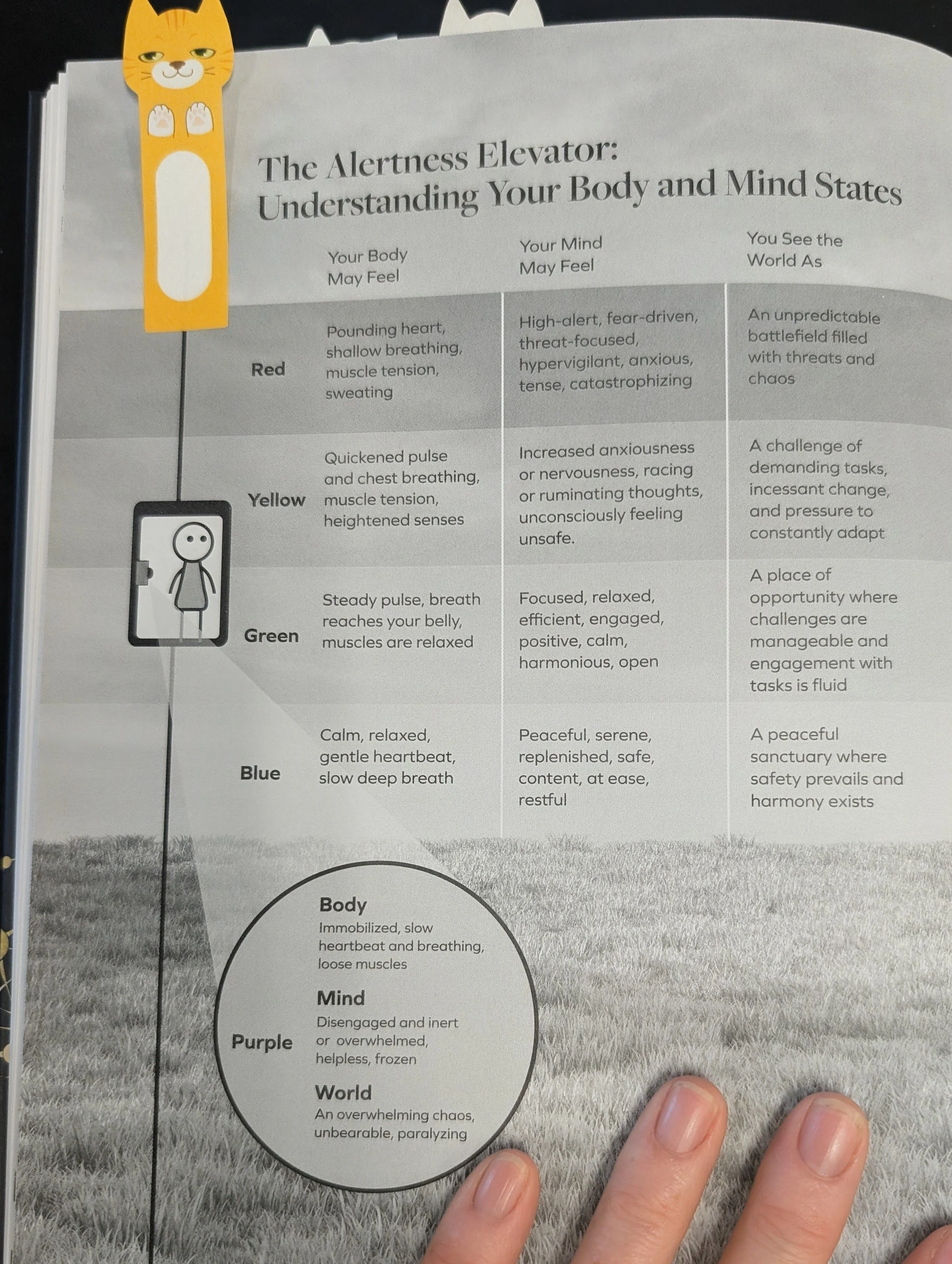
It is constantly scanning for threat or safety, and it responds to what it finds not just through feelings, but through physical sensations too: sleep, digestion, muscle tension, breathing, energy, and how safe or unsettled you feel in your own body.
When life keeps throwing stress at that system (and let’s be honest, modern life is relentless), it can get stuck in a kind of high-alert mode.
The stressful event ends, but your body doesn’t fully get the memo.
It stays braced.
And over time, that braced feeling becomes your baseline.
This isn’t a character flaw.
It’s not weakness.
It’s not you failing at self-care.
It’s physiology.
And more importantly, it can change.
Why the quick fix doesn't work
One of the things I appreciate most about this book is that Dr. Passaler doesn’t promise a magic hack. It’s more like a circular flow of stages we are continually navigating.
She is clear from the start: this is not a “do this one breathing exercise and feel amazing forever” situation. Don’t I wis
Nervous system healing is slow, layered, cumulative work.
She explains that nervous system health rests on four foundational pillars: body, mind, connection, and spirituality.
These are the roots beneath the roots — the foundational terrain that supports everything else.
That distinction matters because so many of us have spent years patching symptoms instead of tending to what’s underneath them.
We manage anxiety instead of shifting our baseline.
We chase relief instead of building resilience.
We treat stress like a problem to solve instead of a signal from a body asking for support.
The shift Dr. Passaler invites us into is subtle, but powerful:
From reactive to proactive.
From how do I calm down right now?
To how do I build a nervous system that doesn’t live on the edge all the time?
That feels huge to me.
On sensitivity (and feeling very seen)
I felt deeply seen reading Dr. Passaler’s section on sensitivity.
She writes about how misunderstood sensitivity is in Western culture — how often it gets framed as weakness, fragility, or something to fix.

Whew, did that land.
Because like any trait, heightened sensitivity can absolutely be challenging in the wrong environment.
But it can also be a gift.
Sensitivity often means deeper processing. More awareness. More nuance. More attunement.
And yet so many of us were taught that sensitivity was a liability — something to toughen up, numb out, or outgrow.
She shares examples that brought me right back to my shy, blushing, deeply-feeling younger years.
From an evolutionary standpoint, sensitivity is not a flaw. It serves a purpose.
All living organisms sense and respond to what’s happening around them. Some are simply more sensitive than others.
The more sensitive ones often pick up on opportunities and threats more quickly. They notice more. Process more. Respond faster.
That can be incredibly useful.
The challenge is that in modern life, many of the “threats” our systems perceive aren’t predators in the wild.
They’re overstimulation. Noise. Pressure. Notifications. Emotional labor. Chronic stress. The relentless hum of too much input.
So yes, sensitivity can be a gift.
But in a world like this, it can also be exhausting.
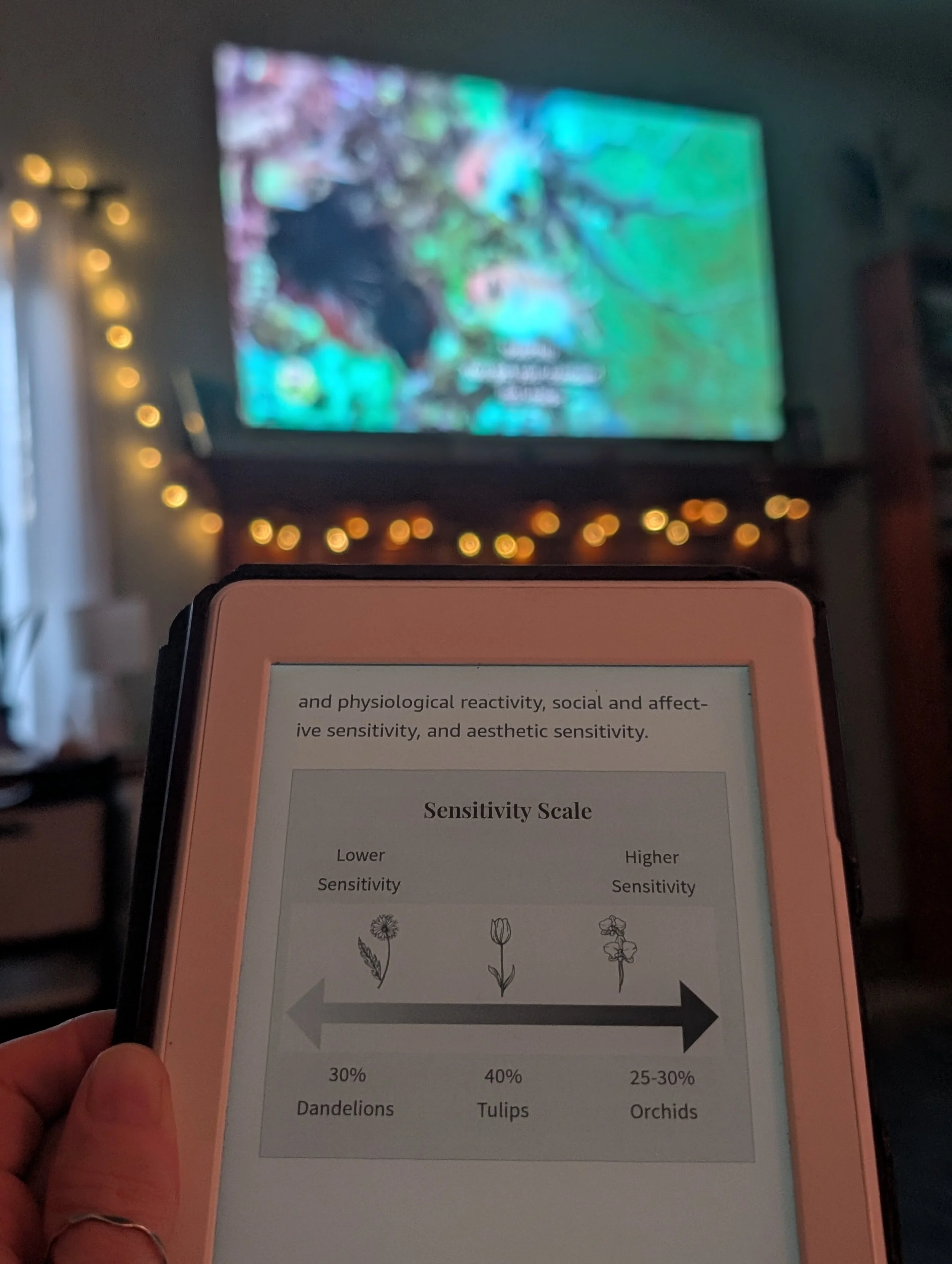
One of the most helpful distinctions in the book was her clarity around the difference between high sensitivity and nervous system dysregulation.
They are not the same thing.
Sensitivity is about how your nervous system takes in and processes information.
Dysregulation is what happens when your nervous system gets stuck in prolonged activation and loses flexibility in how it responds.
In other words: one is your wiring.
The other is what chronic stress does to it.
And in my case?
It’s both.
Lucky me. (I’m the problem it’s me)
The five stages, in a nutshell
The heart of the book is a five-stage plan.
I'm going to create a dedicated post on each one (links below as I write them), but here's the bird's-eye view so you know what we're working toward together:
Stage 1: Awareness
Learning to recognize your own nervous system patterns. Before you can change anything, you need to notice what's actually happening in your body and when.
Stage 2: Regulation

Building tools to create a sense of safety from the inside out. This is where movement, breath, and body practices become your allies.
Stage 3: Restoration
Rebuilding flexibility in your nervous system. This is about recovering capacity, not just coping better.
Stage 4: Connection
Healing in relationship. We are wired to co-regulate with other people, and this stage takes that seriously.
Stage 5: Expansion
Growing your capacity for life, not just managing it. This is the "thriving" part.
What I love about this framework is that it's sequential and gentle.
You're not expected to do it all at once.
You build slowly.
Which, if you know anything about Slow Moves Rox — is very much my / our love language.
Why I'm sharing this with you
I’m at a point in life where I know myself pretty well.
I know what I need.
I have practices.
I have boundaries (mostly).
I’ve walked through enough seasons to trust myself more than I used to.
And still…
I find myself braced.
Reactive.
A beat slower to recover than I’d like.
Reading this book felt like putting on glasses I didn’t know I needed.

Everything got clearer.
I felt my nervous system come down even though I wasn’t doing every single little suggestion laid out in the book.
Like a great big exhale and sigh.
This makes sense.
Over the next few months, I’ll be walking through each of the five stages here on the blog — sharing what resonates, what I’m actually trying, and how it’s landing in real midlife, real-body, real-life terms.
No hype.
No fixing.
Just honest exploration.
Slowly. Together.
If your nervous system has been running a little hot lately — even on the good days — pull up a chair.
Have you read Heal Your Nervous System?
Do you live in the yellow zone too?
Come find me on Instagram/slowmovesrox and tell me where you’re starting.
🌿 Part of the Heal Your Nervous System series
Lately I’ve been slowly working through ideas inspired by Heal Your Nervous System and reflecting on what nervous system healing can look like in real, everyday life.
This series explores gentle structure, sensory support, movement, nourishment, and the small rhythms that help the body feel safe enough to heal.
Read next: